SOSIALISASI PEMERIKSAAN BACTERIAL VAGINOSIS DAN URINE LENGKAP PADA IBU PKK DI DESA SUMBERSONO MOJOKERTO
DOI:
https://doi.org/10.36465/jupemas.v6i2.1766Keywords:
Reproductive health; urinary tract infection; bacterial vaginosis; complete urine analysis; health education.Abstract
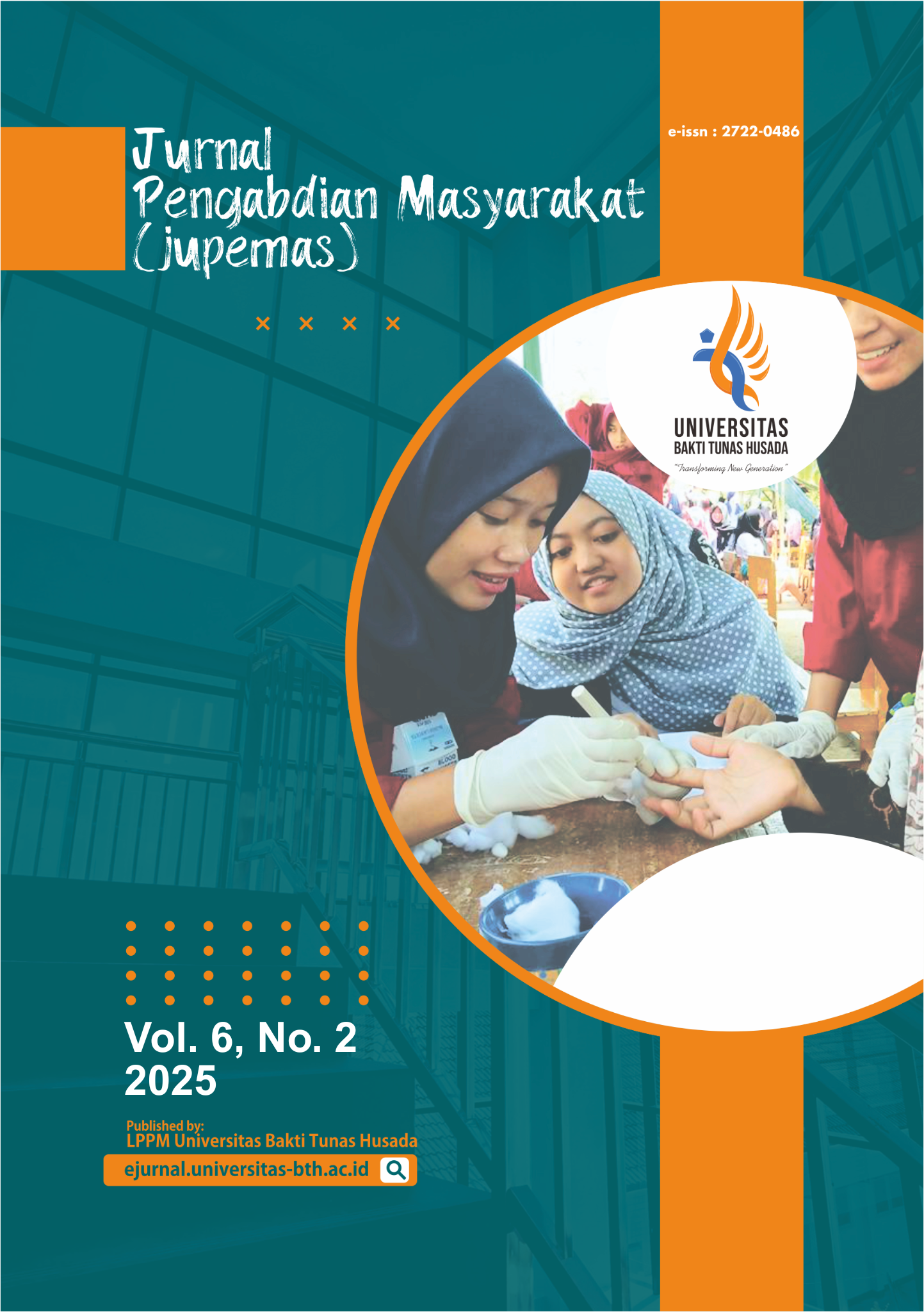
Women's reproductive health, especially among those of reproductive age, is highly susceptible to disorders such as urinary tract infections (UTIs) and bacterial vaginosis (BV). A lack of understanding about risk factors, symptoms, and preventive measures has led to a high incidence of undetected infections. Therefore, education and early detection are crucial steps to reduce the risk of long-term complications. This activity aims to enhance the knowledge of PKK mothers regarding the dangers of UTI and BV, as well as the importance of early detection through health education and simple examinations. The activity was conducted in Sumbersari Village, Sumbersono Village, Mojokerto District, involving 19 female participants. The implementation methods included pre-test and post-test questionnaires, educational material delivery using LCD (Liquid Crystal Display) media, posters, and complete urine examinations and vaginal swabs (Bacterial Vaginosis/BV) with Gram staining. The results showed an increase in participants' understanding post-education from 40-50% to 70-80%. Complete urine tests identified that 50% of participants had uric acid crystals, 30% had cloudy urine, and 10% were positive for BV based on the presence of clue cells. The conclusion of this activity indicates that structured education combined with laboratory examinations can enhance knowledge and awareness of the importance of reproductive health, thereby enabling early prevention through proper hygiene of reproductive organs and regular BV and UL examinations at the community level.
References
Bagnall, P., & Rizzolo, D. (2017). Bacterial vaginosis: A practical review. Journal of the American Academy of Physician Assistants, 30(12). https://doi.org/10.1097/01.JAA.0000526770.60197.fa
Coudray, M. S., & Madhivanan, P. (2020). Bacterial vaginosis—A brief synopsis of the literature. In European Journal of Obstetrics and Gynecology and Reproductive Biology (Vol. 245). https://doi.org/10.1016/j.ejogrb.2019.12.035
Ellington, K., & Saccomano, S. J. (2021). Recurrent bacterial vaginosis. Nursing, 51(3). https://doi.org/10.1097/01.NURSE.0000724356.86273.e7
Ignacio, M. A. de O., Buesso, T. S., Morales, J. A. P., Silva, M. de C., da Silva, M. G., & Duarte, M. T. C. (2023). Factors associated with bacterial vaginosis in women with homosexual, bisexual and heterosexual practices. Brazilian Journal of Infectious Diseases, 27(3). https://doi.org/10.1016/j.bjid.2023.102760
irawan, erna. (2018). Faktor-Faktor Penyebab Infeksi Saluran Kemih (ISK) (Literature Review). Prosiding Seminar Nasional Dan Penelitian Kesehatan 2018, 1(1). https://doi.org/10.31227/osf.io/yt8nz
Lase, D. M., Tarigan, R. V. Br., & Situmorang, P. R. (2023). ANALISIS JUMLAH LEUKOSIT DAN ERITROSIT PADA URINE LENGKAP PASIEN INFEKSI SALURAN KEMIH (ISK) DI RUMAH SAKIT SANTA ELISABETH MEDAN TAHUN 2023. Journal of Indonesian Medical Laboratory and Science (JoIMedLabS), 4(2). https://doi.org/10.53699/joimedlabs.v4i2.153
Mano, D., Santoso, A. H., Satyanegara, W. G., Wijaya, D. A., Nathaniel, F., Alifa, T. P., Kaminto, E. R., Ezra, J., Marcella, A., Mikrobiologi, B., & Kedokteran, F. (2023). PENYULUHAN DAN DETEKSI INFEKSI SALURAN KEMIH PADA ORANG LANJUT USIA. Community Development Journal : Jurnal Pengabdian Masyarakat, 4(6).
Maulani, D., & Siagian, E. (2022). Hubungan Pengetahuan Dan Kebersihan Urogenital Dengan Infeksi Saluran Kemih. Jurnal Penelitian Perawat Profesional, 4(4).
Mokwele, R. N., Ndzamba, B. S., & Schellack, N. (2023). Bacterial vaginosis: an overview. SA Pharmaceutical Journal, 90(1). https://doi.org/10.10520/ejc-mp_sapj_v90_n1_a8
Mondal, A. S., Sharma, R., & Trivedi, N. (2023). Bacterial vaginosis: A state of microbial dysbiosis. In Medicine in Microecology (Vol. 16). https://doi.org/10.1016/j.medmic.2023.100082
Muzny, C. A., Łaniewski, P., Schwebke, J. R., & Herbst-Kralovetz, M. M. (2020). Host-vaginal microbiota interactions in the pathogenesis of bacterial vaginosis. In Current Opinion in Infectious Diseases (Vol. 33, Issue 1). https://doi.org/10.1097/QCO.0000000000000620
Muzny, C. A., & Schwebke, J. R. (2016). Pathogenesis of Bacterial Vaginosis: Discussion of Current Hypotheses. Journal of Infectious Diseases, 214. https://doi.org/10.1093/infdis/jiw121
Pardede, S. O. (2018). Infeksi pada Ginjal dan Saluran Kemih Anak: Manifestasi Klinis dan Tata Laksana. Sari Pediatri, 19(6). https://doi.org/10.14238/sp19.6.2018.364-74
Parwati, P. A., Prabangkara, N. M. I., & Mulyantari, N. K. (2022). Gambaran hasil ph dan keton pada urine puasa. Bali Medika Jurnal, 9(2). https://doi.org/10.36376/bmj.v9i2.311
Rinawati, W., & Aulia, D. (2022). Update Pemeriksaan Laboratorium Infeksi Saluran Kemih. Jurnal Penyakit Dalam Indonesia, 9(2). https://doi.org/10.7454/jpdi.v9i2.319
Ruckle, A. F., Maulana, A., & Ghinowara, T. (2020). FAKTOR RESIKO INFEKSI SALURAN KEMIH PADA PASIEN DENGAN BATU SALURAN KEMIH. Biomedika, 12(2). https://doi.org/10.23917/biomedika.v12i2.10812
Takemoto, M. L. S., De Oliveira Menezes, M., Polido, C. B. A., De Souza Santos, D., Leonello, V. M., Magalhães, C. G., Cirelli, J. F., & Knobel, R. (2019). Prevalence of sexually transmitted infections and bacterial vaginosis among lesbian women: Systematic review and recommendations to improve care. In Cadernos de Saude Publica (Vol. 35, Issue 3). https://doi.org/10.1590/0102-311X00118118
Triyani, N. N., Arsana, I. N., & Sudaryati, N. uh G. (2023). INFEKSI SALURAN KEMIH PADA PASIEN DIABETES MELITUS. JURNAL WIDYA BIOLOGI. https://doi.org/10.32795/widyabiologi.v13i02.3565
van Schalkwyk, J., Yudin, M. H., Allen, V., Bouchard, C., Boucher, M., Boucoiran, I., Caddy, S., Castillo, E., Kennedy, V. L., Money, D. M., Murphy, K., Ogilvie, G., & Paquet, C. (2015). Vulvovaginitis: Screening for and Management of Trichomoniasis, Vulvovaginal Candidiasis, and Bacterial Vaginosis. Journal of Obstetrics and Gynaecology Canada, 37(3). https://doi.org/10.1016/S1701-2163(15)30316-9